
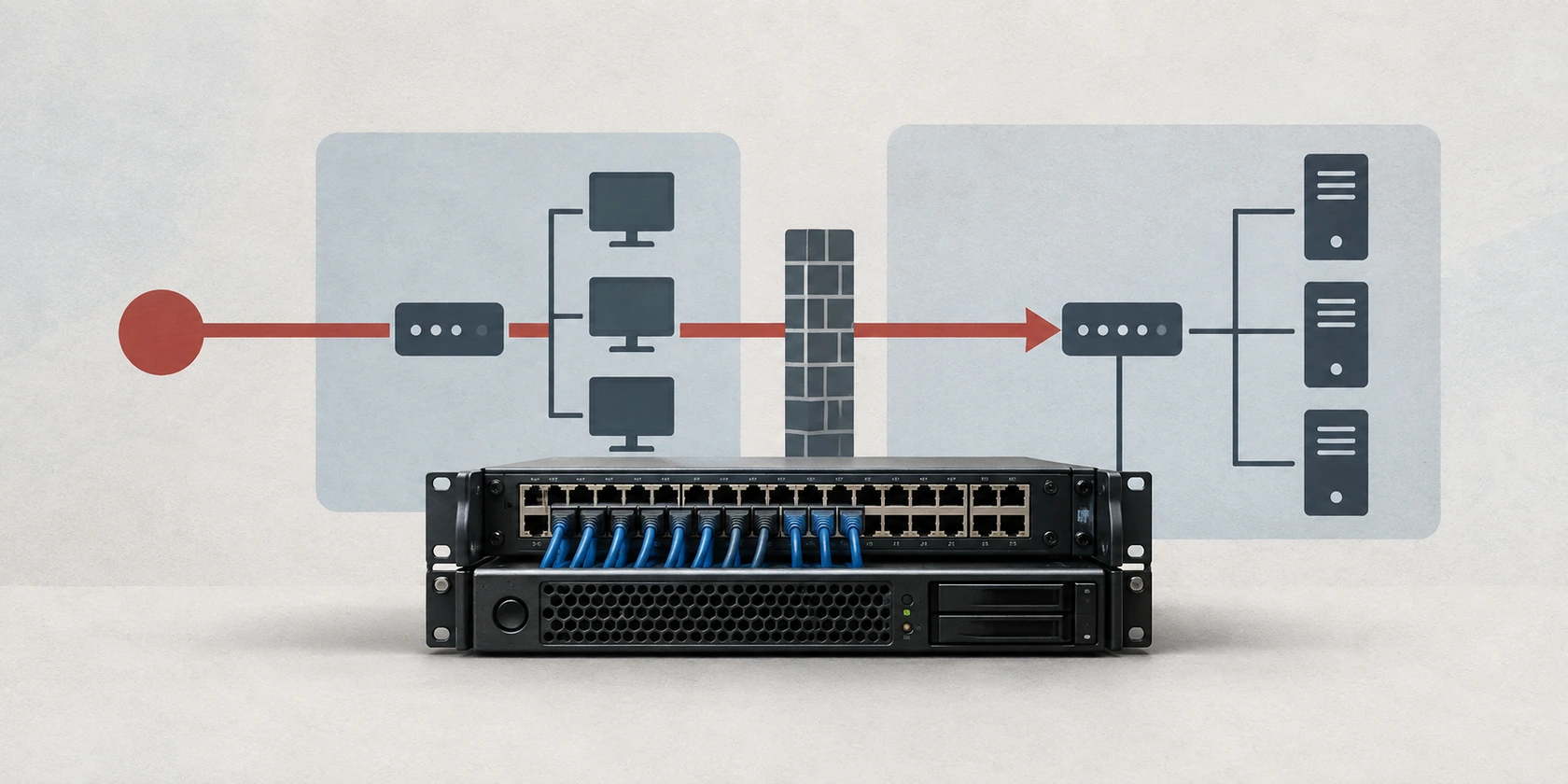
Infrastructure pentesting and network security audit
Red TeamAssess services, identities and network boundaries. Use switch, router and firewall evidence to review L2–L4 threats, Cisco and MikroTik management exposure, and FortiGate decisions using FortiGuard. Deliver an assessment with reproducible acceptance checks.
What you will produce
- Assigned-VM and service inventory with commands, times, and versions.
- Supplied-identity policy record and one permission analysis.
- Vendor-patch applicability card separating installed and running kernels.
- Segmentation matrix with positive and negative controls.
- A finding with raw evidence, limitations, owner decisions, and reproducible retesting.
- Recovery acceptance record with elapsed time, loss interval and application reconciliation.
- Shift handover covering EDR visibility and network attribution limits.
- Three L2–L4 control findings with a control trace and acceptance criteria.
- Cisco and MikroTik advisory records with IP and MAC management boundaries.
- Fortinet PSIRT applicability decision and FortiGate policy, profile, rating and outcome matrix.
Prerequisites
Or equivalent skills: Open a terminal and read existing-tool help.; Explain IP addresses, ports, domains, users, and file permissions after the foundations.; Define an approved assessment scope and restore your own VM snapshot..
Practice labs for this course
Browse all labs- One maintenance slot before the shift ends
- Which connection is covered by the contractor’s approval?
- Which finding is ready to close?
The labs are in Russian. To open the exercise files, sign in with an account assigned to the corresponding corporate programme.
Course modules
16 modules · 42 hours01Your first network: isolated GOAD and readable Nmap outputFree
Prepare a lab, explore Nmap through safe actions, and build your first service inventory.
GOAD-LightIsolationNmapPort statesInventoryTheoryKnowledge checks4–6 hours including lab setupOpen module02DNS, SMB, and LDAP — turn ports into a readable map
Explore protocol clients and confirm a domain name, shared folder, and one GOAD directory record.
DNSSMBLDAPNetExecAccess failuresTheoryKnowledge checks3 hoursOpen module03Account assessment — policy, state, and evidence boundaries
Inspect password settings and supplied-user metadata without obtaining secrets.
Password policyNetExecIdentity metadataLockoutEvidenceTheoryKnowledge checks3 hoursOpen module04Linux: a readable file behind an inaccessible path
Inspect ownership, groups, directory traversal, and ACLs on your own Linux VM.
LinuxDACACLnameiAccess verificationTheoryKnowledge checks2–3 hoursOpen module05Kernel CVEs in 2026: applicability, packages, and the running version
Assess CopyFail and DirtyFrag using official vendor status without exploitation.
CopyFailDirtyFragVendor advisoryBackportRetestTheoryKnowledge checks2–3 hoursOpen module06Windows: user tokens, NTFS, and a shared folder
Assess one permitted action and distinguish group membership from effective access.
WindowsAccess tokenNTFSShare ACLUACTheoryKnowledge checks2–3 hoursOpen module07macOS: file permissions, app consent, and system protection
Distinguish DAC, TCC, and SIP using a safe note and a supplied case.
macOSDACTCCSIPPrivacy controlsTheoryKnowledge checks2–3 hoursOpen module08Segmentation: verify permitted connectivity and a closed boundary
Build a matrix of vantage points, routes, and TCP states without changing routing.
Segmentationip routeNmapPositive controlEvidenceTheoryKnowledge checks3–4 hoursOpen module09INFRA capstone: evidence, owner decisions, and retesting
Combine inventory, permissions, patch status, and segmentation into a reproducible approved assessment.
ScopeEvidenceReportingRemediationRetestTheoryKnowledge checks4–6 hoursOpen module10Veeam recovery acceptance for a business service
Assess the chosen recovery point, recovery objectives, elapsed time and application acceptance against independent evidence.
Veeam SureBackupRPO and RTORecovery acceptanceTheoryKnowledge checks2 hoursOpen module11CrowdStrike Falcon and SentinelOne Singularity Endpoint: measuring EDR visibility
Correlate heartbeats, delayed events, flow records and agent assignments. Decide which claims about a tunnel or endpoint protection have evidence.
CrowdStrike FalconSentinelOne Singularity EndpointVPN, NAT and event provenanceTheoryKnowledge checks2 hoursOpen module12L2. ARP, loops and trunk VLAN controls
Compare a trunk, ARP cache and STP evidence against the approved branch design.
ARP spoofingLoops and STP802.1Q VLAN boundariesTheoryKnowledge checks2 hoursOpen module13L3. Source validation and asymmetric routing
Explain a reverse-path decision using VRF, time windows and branch provenance.
IP spoofing and source validationVRF and reverse pathsAsymmetryTheoryKnowledge checks2 hoursOpen module14L4. TCP states, overload and resource boundaries
Separate firewall state exhaustion, server accept queues and delayed application receipts.
SYN floods and retransmissionsTCP statesQueue and connection-table capacityTheoryKnowledge checks2 hoursOpen module15Cisco IOS XE and MikroTik RouterOS. Management boundaries and update applicability
Assess a Cisco advisory and active SMUs, then distinguish the boundaries of IP WinBox and MAC WinBox on RouterOS.
Cisco IOS XEMikroTik RouterOSWeb UIMAC WinBoxTheoryKnowledge checks2 hoursOpen module16FortiGate and FortiGuard. PSIRT applicability, web-filter coverage and logs
Scope a FortiOS advisory and distinguish the selected profile, rating result and actual gateway action.
FortiGateFortiOSFortiGuardPSIRTWeb FilterTheoryKnowledge checks2 hoursOpen module
Sources and documentation
- GOAD installation
- GOAD management
- HackTricks methodology — original author source
- Orange Cyberdefense mindmaps
- Nmap reference
- NetExec LDAP query
- Linux path resolution
- Windows ACL inspection
- Apple app file access
- CopyFail vendor status
- DirtyFrag vendor status
- NIST assessment planning
- Veeam · SureBackup
- Veeam · Verification job statistics
- Veeam · KB4948
- CrowdStrike · FalconPy Hosts
- SentinelOne · Product FAQ
- MITRE ATT&CK · Proxy
- IETF · RFC 826, An Ethernet Address Resolution Protocol
- Cisco · VLAN trunking
- Cisco · Spanning Tree Protocol
- IETF · RFC 3704, Ingress Filtering for Multihomed Networks
- IETF · RFC 9293, Transmission Control Protocol
- Linux kernel · IP Sysctl
- Cisco IOS XE Web UI advisory and first fixed releases
- MikroTik CVE-2023-30799
- RouterOS MAC server
- Fortinet PSIRT FG-IR-23-385
- FortiOS web filter error logs
- FortiOS rating options
The remaining modules open after you buy the course.
About this course
Assess services, identities and network boundaries. Use switch, router and firewall evidence to review L2–L4 threats, Cisco and MikroTik management exposure, and FortiGate decisions using FortiGuard. Deliver an assessment with reproducible acceptance checks.
What you will learn
- Introduce Nmap and NetExec before approved health checks
- Separate authentication, authorisation, and file permissions
- Match patches to the exact product and active kernel
- Preserve evidence and control retesting
- Relate ARP, STP, routing decisions and TCP state evidence to control scope and capacity limits.
Who this course is for
For anyone looking to build skills in this field and apply them at work. Explore the first module to see the level and learning format.
How you will learn
Work through the modules: study a case, complete the exercise, check your understanding and save your progress. The first module is open without an account.