
OSINT from zero: search queries and an organisation dossier
Contents
- Lesson 1. Define the question before collecting results
- Lesson 2. Precise searching: make every query an experiment
- Lesson 3. Identifier joins: website → legal details → official register
- Lesson 4. Source history: what was written at an earlier time?
- Practice. Build the dossier using existing tools
- Sources and currency
Which record belongs with Mayak Lab?
Compare two fictional identifiers from a web page with two candidate records. 39s · with narration and captions.
Video transcript
OSINT means collecting and evaluating information from open sources. A source might be a museum page, a registry extract, or a photograph of a public square. Open access does not automatically make information accurate, free to download in bulk, or suitable for every later use. This module addresses a narrow workplace question: which organisation is identified on a supplier website, and which documents support that connection?
Start with a browser, a plain-text editor, and a folder named osint-case. Use an existing Excel installation or free LibreOffice Calc for tables. Download from the project website and record the installed version shown in Help → About. LibreOffice is free software; its licensing terms are available on the project website. You do not need to program to complete this module. Open exercise files as data, without enabling macros or installing extensions from untrusted tutorials.
Lesson 1. Define the question before collecting results
A purchasing team receives an offer from “Mayak Lab”. Two organisations use similar names. Your task is to associate one particular website with a legal entity at a stated observation date. A legal entity is a registered organisation, such as a limited liability company. Its name may change or resemble another company’s name. Russia’s INN identifies a taxpayer; OGRN identifies the state-registration entry. For a company these are stronger search keys than a logo or abbreviated trading name.
Write the question: “Which legal entity does mayak-lab.example identify as its operator on 6 October 2026?” The .example domain is reserved for examples. Do not attempt to visit it or submit our invented identifiers to government services. For an external exercise, use your own organisation, an organisation that agreed to participate, or a public institution. Researching an organisation does not require collecting employees’ home addresses, searching leaked databases, or entering other people’s accounts.
Create case.md with four fields: object, question, date, and allowed sources. Add stopping conditions: an unavailable page is recorded as unavailable; access protections are not bypassed; incidental personal details are excluded from the exercise report. OPSEC means organising your work to avoid unnecessary exposure and loss of control. Here it means a separate browser profile without personal account sessions, updated software, and no unknown extensions. An incognito window does not hide a query from the search provider or network provider.
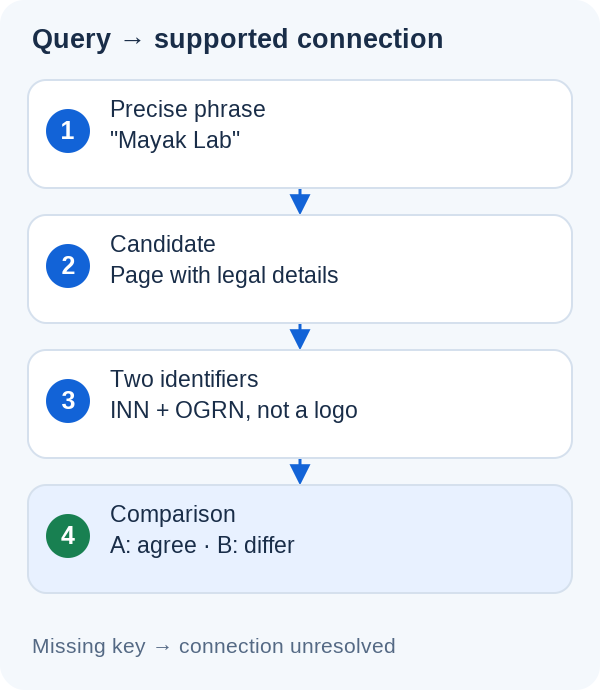
The diagram moves from matching words to a candidate, an identifier, and a supported connection. Each arrow requires an additional observation.
Lesson 2. Precise searching: make every query an experiment
The T.Hunter Habr tutorial discusses search operators. We apply this approach to our own case rather than reproducing its investigations. An operator is syntax that changes a query’s conditions. Quotation marks constrain a phrase, site: selects a domain, filetype: selects a document format, and a minus excludes a word. These forms are checked against Google’s official help.
First explore the search page: the query box accepts words, the browser address bar accepts URLs, and the result list offers candidates. For the playground, enter a known public museum name such as “State Hermitage Museum”, open one result, and return. Compare the quoted name with a site: restriction to the museum’s already-verified official domain. Locate a result’s address, title, and snippet. You are ready when you can open the original page and explain why a similar title does not establish its affiliation. Do not preserve visitors’ or staff details: our object is the public institution.
"Mayak Lab"
site:mayak-lab.example "INN"
site:mayak-lab.example filetype:pdf
"Mayak Lab" -jobs
These are a query plan for a fictional object, not a promise of live results. Substitute an agreed real name and domain for external practice. Enter one query, open a relevant result, and locate the phrase in the actual document. The short description below a search result is a snippet. It can be old, shortened, or assembled from different parts of a page. It helps you locate material; it does not replace the material.
Record the exact query, time, selected result, and selection reason. If the quoted phrase returns nothing, remove the quotes or check an alternative spelling. Record zero results as an outcome of this query, not proof that the organisation does not exist. Use a negative control: a search for “Mayak” alone should produce excessive ambiguity. A method that accepts all of those results cannot separate the target from namesakes. Do not repair this by inventing a location; establish the location from a reliable source first.
Search providers can omit documents, personalise ordering, or change operators. Date filters refer to the provider’s interpretation of document dates. They do not independently establish when the underlying event happened. Your query log should therefore describe what you observed rather than claim exhaustive coverage of the internet.
Lesson 3. Identifier joins: website → legal details → official register
The Habr counterparty case illustrates moving from website pages to company details. We use that transition, not the author’s judgements about business reliability. Open the contact page, sales terms, or site policy. Record the stated organisation and identifiers alongside the specific page URL. Missing legal details are a gap requiring another source, not a completed finding of fraud.
Before the main case, explore the FNS form: its search field accepts details or a name, and results below are candidates. Search a public institution by name without automatically selecting the first row. Compare this with an exact identifier obtained from that institution’s official website. Finally clear the query and remove a retained region filter: an old filter can hide a result. Readiness means identifying your input, opening the intended record, and explaining the fields used to select it. Record service unavailability separately from a query returning no result.
For real practice, use the FNS extract service, search with the observed INN or OGRN, and compare both identifiers against the website document. Save the extract, its generation date, and fields relevant to your question. FNS describes electronic extracts in its official guidance. EGRUL is Russia’s legal-entity register. It establishes registration information; it is not a complete list of litigation and does not demonstrate service quality.
For accounting information, use the FNS accounting-information resource, known in Russian as GIR BO. Select the organisation by identifier, then the relevant reporting year and document type. Reporting year, publication date, and today’s date are different. An unavailable file does not demonstrate zero revenue. A missing reference to a tax regime in a registration extract does not establish which tax regime applies.
Explore the accounting resource before analysing it: locate an agreed public organisation by identifier, inspect available periods, then switch the year and compare document listings. Record an unavailable record or file honestly. You are ready when you can identify the selected entity and reporting year rather than only a generic search result. Organisation types and information are not uniformly covered; review the resource’s official description before assuming completeness.
Save this synthetic export as records.csv. It is not a replica of an official extract. The DEMO-* markers are deliberately invalid INN/OGRN values and must not be submitted to external services.
source,name,inn,ogrn,observed
site-policy,Mayak Lab,DEMO-INN-A,DEMO-OGRN-A,2026-10-06
registry-A,Mayak Laboratory LLC,DEMO-INN-A,DEMO-OGRN-A,2026-10-06
registry-B,Mayak Lab LLC,DEMO-INN-B,DEMO-OGRN-B,2026-10-06
Row B’s matching short name does not overcome two different identifiers. A supported website-to-company connection also does not establish the authority of every person who sends a message using the company’s name. Those are separate questions with different evidence requirements.
Lesson 4. Source history: what was written at an earlier time?
The Nubes practical investigation includes website history. Begin with the exact page address, such as its policy URL, rather than a guess about the organisation. In Wayback Machine, enter that URL and inspect an available capture before the disputed date and the next available capture afterwards. A capture is an archived response, not a guarantee that every part of a site was preserved.
Short Wayback playground: archive https://example.com/, open an available capture, then inspect another year. Compare the original URL with the archived address containing capture time. If the archive fails, record the error and retry later. Readiness means locating capture time and distinguishing it from an event date inside the text. Module four provides a fuller interface walkthrough.
Compare identifiers and statements in the document. A changed logo or font does not itself indicate a new legal entity. If a 2024 capture identifies DEMO-INN-B and the current page identifies DEMO-INN-A, record that the observed text differs between the two observations. Do not assign an exact transition date when there are no intervening captures. The archive calendar supports capture timing, not the truth of the page, its authorship, or the company’s opening date.
A negative control is an invented page URL or a page known to lack accessible captures. An empty calendar should yield “no archival data obtained”. Access failures, archiving restrictions, and a page that was never published can produce similarly empty results. Without additional evidence you cannot distinguish those explanations. Module four develops this into a machine-readable chronology.
Practice. Build the dossier using existing tools
Explore the spreadsheet first. Open an empty Calc/Excel sheet: a cell is one box, columns have letters, and rows have numbers. Enter “Source” in A1 and “Identifier” in B1, then add two teaching records below. Change one cell, undo the change, and save the workbook to your working folder. Close and reopen it. You are ready when you distinguish rows from columns and can undo your own edit. CSV is delimited plain text; a workbook also stores sheets and comments.
Save the lesson-three CSV as records.csv using a plain-text editor. Open it in Calc with File → Open. In the import dialog select UTF-8 and the comma separator, then inspect the preview: five columns and three data rows are expected. Set identifier columns to Text. Real identifiers can contain leading zeroes that numeric conversion would destroy. If everything appears in one column, cancel and correct the delimiter instead of moving values by eye. The Calc documentation describes CSV import.
Add columns named decision and reason. Locate the website row and highlight its two identifiers. Compare them with each registry row. Enter MATCH — both keys agree for A and REJECT — both keys differ for B. This evaluates association with the website; it does not say that B is dishonest or nonexistent. Save the working file as ODS to retain your notes and formatting rather than relying on CSV to preserve them.
Duplicate the sheet and name it “Negative control”. Remove the website’s INN. Neither A nor B can now pass the strict two-key policy: record UNRESOLVED — missing key. Restore the INN and change only B’s attractive name. Its rejection should remain. Finally change A’s OGRN to another exercise marker: one matching INN does not satisfy this teaching policy. These variations reveal which fields actually determine your decision.
Submit case.md, a four-query search log, the original CSV, the ODS workbook with its control sheet, and three final claims: the current association, the rejected namesake, and the unknown exact transition date. Each requires its source, observation time, limitation, and next step. Repeat the manual workflow for an agreed organisation, preserving real page URLs and the extract. External results depend on publications and service availability. The exercise table teaches comparison but does not replace that external verification.
Sources and currency
The search, identifier, and history methods are cross-referenced to the Habr articles above; the scenario, records, and control tables are original course material. Documentation was reviewed on 6 October 2026. Check technical search behaviour in Google Search Help and registration services through FNS. This exercise does not provide a legal opinion, a financial audit, or a guarantee that a counterparty is trustworthy.
Do two websites mean two sources?
Change the conditions and observe this training model. It runs in your browser and does not change your computer.
Three publications report a company relocation. Which ones provide independent support?
Choose conditions above to see an explanation of the result.
Independent exercise · Russian

Закупщик готовит справку о вымышленном поставщике «Маяк Сборка». Поиск по названию смешал карточки двух организаций. В комплекте лежат выдержки из публичных реквизитов сайта, реестра и каталога отраслевой выставки. Для упражнения полные регистрационные номера везде заменены одними и теми же условными метками.
Evidence
Сайт в разделе реквизитов от 12 ноября 2026 года указывает метку ИНН-А и город Киров. Учебная выписка реестра связывает ИНН-А с ООО «Маяк Сборка» в Кирове, ИНН-Б — с одноимённым ООО в Пскове. Каталог выставки 2025 года содержит название и Псков, а идентификатор участника пропущен.
Assignment
Подготовьте карточку кировского поставщика с двумя источниками и датой среза. Запишите поисковый запрос для отбора документов и решение по упоминанию в выставочном каталоге.
Compare your reasoning
Сайт и реестр соединяются по ИНН-А. Для отбора подойдёт запрос с названием в кавычках и Кировом, затем каждый результат нужно сверить по реквизитам. Участие кировской компании в выставке не подтверждено. Псковский выпуск можно сохранить в примечании с указанием причины исключения.
Search: three source decisions
Synthetic training cards. Explain what the source establishes, then choose a next action. These exercises are ungraded.
Two matching names
A: Mayak Lab, training identifierTRAIN-COMPANY-017
B: Mayak Lab, no identifier
A name match identifies a candidate. Check registration details, domain or reciprocal contact links and the origin of each field; without a key the link remains a hypothesis.
Names are neither unique nor immune to copying. Record the missing corroboration instead of turning a search match into a fact.
A logo can be reproduced. It is weaker than a verifiable identifier and does not replace an independent source.
Review every option
- Keep a hypothesis and find a second verifiable identifier
A name match identifies a candidate. Check registration details, domain or reciprocal contact links and the origin of each field; without a key the link remains a hypothesis.
- Yes, identical names always identify one company
Names are neither unique nor immune to copying. Record the missing corroboration instead of turning a search match into a fact.
- Yes, if the logos also look similar
A logo can be reproduced. It is weaker than a verifiable identifier and does not replace an independent source.
An old page copy
Current page: no address
Archived snapshot: 2021-05-12, address shown
Separate the event date, publication date and archive access time. The archive supports page history but not a claim that the address is current.
That moves an old observation into the present without a check. Find a current primary record or explicitly preserve uncertainty.
An old snapshot can establish page history. Limit your conclusion to its date and preserve the snapshot URL.
Review every option
- The2021snapshot showed an address; its current status is unconfirmed
Separate the event date, publication date and archive access time. The archive supports page history but not a claim that the address is current.
- The company is at that address now
That moves an old observation into the present without a check. Find a current primary record or explicitly preserve uncertainty.
- The snapshot is useless because it is old
An old snapshot can establish page history. Limit your conclusion to its date and preserve the snapshot URL.
Search found nothing
"Mayak Lab" "TRAIN-COMPANY-017" → no matching results
Change one variable, such as retaining the exact name without the second key. Record query, date and results; lack of indexing does not establish absence.
Search coverage is incomplete. An empty result may reflect wording, indexing or region and cannot replace a registry check.
Additional restrictions usually narrow results. Identify the overly strict condition and repeat the search in a controlled way.
Review every option
- Relax one constraint, record the query and compare
Change one variable, such as retaining the exact name without the second key. Record query, date and results; lack of indexing does not establish absence.
- Declare that the company does not exist
Search coverage is incomplete. An empty result may reflect wording, indexing or region and cannot replace a registry check.
- Put even more words inside quotation marks
Additional restrictions usually narrow results. Identify the overly strict condition and repeat the search in a controlled way.
Personal practice environment
Check an excerpt, find matching lines and compute the SHA-256 of the original text. Temporary data expires after 30 minutes or when you close the environment.
Sign in