
Counterparty checks: Wayback, publications, courts, and an evidence report
Contents
- Lesson 1. Explore Wayback Machine using a known page
- Lesson 2. Identifier method: join documents about the same organisation
- Lesson 3. Public-status method: Fedresurs, courts, and procurement
- Lesson 4. Independence, contradictions, and confidence
- Practice. Produce a short, re-checkable report
- Sources and currency
You can now search for a page and read a service card. The next task is a workplace question with apparently conflicting sources. A company announced a move in 2025. Today a blog repeats that statement, a register shows another city, and a search engine surfaces an old court-related publication. What can you tell a manager without turning a collection of links into an accusation?
Correlation means comparing observations by entity, time, and meaning. Verification means evaluating a specific claim. “The company is registered in Kazan”, “the company has an office in Kazan”, and “all employees moved to Kazan” are different claims. One document can support the first and say nothing about the third. We use a browser and an existing spreadsheet, without code or mandatory paid databases.
Lesson 1. Explore Wayback Machine using a known page
An archive helps inspect an earlier version of a public page. The Habr Wayback article highlights incomplete captures. We apply page-history checking to an organisation rather than private correspondence. Open Wayback Machine, enter https://example.com/, and inspect an available calendar. Find a year, a captured day, and a time. If the service is unavailable, record the time and message and retry later; that is not absence of page history.
Playground: open an available capture, select another year, copy the complete archived-view URL, and compare it with the original URL. The archive address contains capture timing. Next try the invented path https://example.com/academy-never-published-demo. No accessible captures is the expected control, but it does not prove that no similar page ever existed. You are ready when you distinguish an original address from a capture address and capture time from the event date stated in the page.
For your organisation, choose the exact page containing the relevant claim: policy, contact details, or news. Inspect an available capture before the disputed event and the next afterwards. Preserve the URL, capture time, and text with context. Images, attachments, and separately loaded content may be missing. An empty archived region does not prove that the original site was empty. A newly saved copy cannot be presented as old evidence; its new capture date remains new.
The CDX service provides a capture index; its official documentation helps interpret fields. Required practice uses the calendar and browser view. An absent index entry and unavailable captured content are different outcomes.
Lesson 2. Identifier method: join documents about the same organisation
The Habr counterparty investigation starts from legal details on a website. Use that entry point while tracking the origin of every document. A company can have an old name, a trading brand, and several namesakes. Compare INN/OGRN identifiers, dates, and the organisation’s role in the document; never merge records based only on “Mayak”.
The previous module established the teaching object DEMO-INN-A associated with the website. External practice substitutes a verified identifier for a public organisation. EGRUL answers registration questions; accounting records answer questions about a particular reporting period. The commercial-court catalogue and public procurement system add different document types. No result in one system does not establish the absence of every event involving a company.
Teaching documents, not real registry entries:
D1: site A, 2025-04-02, “we opened an office in Kazan”
D2: blog B, 2025-04-03, copies D1 and links to it
D3: EGRUL, 2026-10-06, DEMO-INN-A, registered city Nizhny Novgorod
D4: procurement DEMO-CONTRACT-13, DEMO-INN-A, supplier role
D5: court case A-DEMO-41/2026, DEMO-INN-A, claimant role
D1 and D3 do not contradict each other when one concerns an office and the other registration. A company can have an office in another city. D4 identifies a role in one contract, not the quality of every contract’s performance. D5 identifies the company as a claimant; it does not establish that the company breached an agreement. Preserving these distinctions is analytical work rather than unnecessary wordplay.
Lesson 3. Public-status method: Fedresurs, courts, and procurement
The Fedresurs Habr author works with entity and publication identifiers. We use this approach without transferring old undocumented backend APIs, proxies, or spoofed headers. A public card and document matter more than a promise that a script checks everything. Open Fedresurs, identify the organisation using verified details, then open an accessible publication. Read its number, date, type, stated object, and visible status indicators. A participant’s publication is not independent expert validation of its contents.
First explore a known public organisation’s card, open one publication, and return to the list. Next change the date period and observe how a filter affects results. Finally compare two publication numbers. You are ready when you distinguish the company card from a particular publication link. Paid access, login requirements, and blocked content are limitations to record; do not bypass them or replace them with an invented clean result.
Annulment, correction, and later publications can change interpretation. The operator’s own manual describes publication states. A search headline cannot establish which document is current. Open a related publication when available and preserve the observed chain.
Now explore the commercial-court catalogue. Identify participant, role, period, and case-number filters. Without submitting a query, change a role and reset the filters. Then make one search for an agreed organisation, open a case, and inspect an available judicial act. Record case number, court, act date, party role, and procedural outcome. A registered claim is not a final decision. A first-instance decision is not the end of the complete history without checking later acts.
In Russia’s public procurement system, distinguish a notice, a contract-register entry, and a performance document. Locate the relevant section through site navigation, review filters, and search using organisational details and a period. Match the supplier’s identifier in the document, preserving record number and status. A notice does not mean a contract was signed; signing does not establish successful performance. If the interface differs or a document is unavailable, consult official help and record the outcome without inventing it.
Lesson 4. Independence, contradictions, and confidence
A URL is where you obtained material. Provenance concerns who created a claim and what it rests on. A blog copying a press release adds a second URL, not a second independent observation. An analytics service using FNS data does not become another primary register. For each claim follow links towards the original and identify exactly what the source supports.
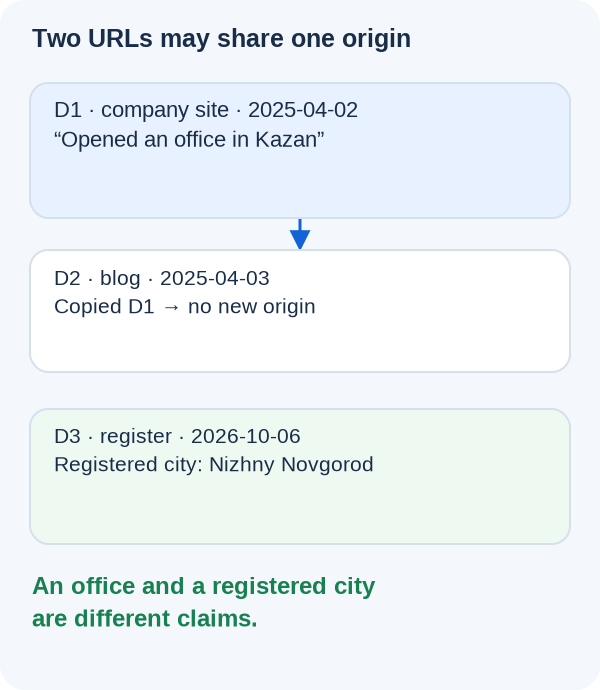
Check the teaching chain: D1 preceded D2; D2 points to D1; D3 originates in a register and describes a different kind of address. “Three websites prove the whole company moved” fails twice: there are fewer than three independent origins, and the statements have different meanings. The supported conclusion is “the site announced an office; the extract identifies another registered city; an organisation-wide move is unestablished”.
Explain confidence in words. High confidence within a narrow question means identifiers agree, the document covers the relevant time, content was inspected, and important contradictions are explained. Moderate confidence can mean that part of a link depends on the company’s own statement. Insufficient evidence can mean only a similar name or inaccessible content. Do not invent a percentage without a model and validated error statistics. Confidence attaches to a specific claim, not a whole company or person.
Practice. Produce a short, re-checkable report
In an existing spreadsheet create columns for claim, entity/ID, document, event date, observation date, provenance, result, and limitation. Enter D1–D5. Expected findings: the company announced an office; the teaching extract supports a registered city; supplier and claimant roles concern specific entries; wrongdoing and an employee-wide move remain unestablished.
Add a control publication: M-17, published 2026-08-01. The next row is M-18, 2026-08-03, annuls M-17. Preserving only M-17’s headline and describing it as current fails the control. Correct the conclusion while retaining both the earlier publication and later annulment. Then change D5’s identifier to B. The case must leave A’s dossier instead of remaining because the name resembles A.
Submit the table, a separate list of original document URLs, and a one-page report containing the question, supported observations, hypotheses, limitations, and next step. External practice uses one agreed organisation and genuine links to public documents, without personal details unnecessary to the question. If a service fails, record time and error, retry later, or submit the unfinished branch. Do not conceal it behind “no adverse information found”.
Sources and currency
The three Habr approaches here are archived-page retrieval, identifier-led research, and publication-record inspection. Examples and comparison rules are original. Service behaviour was cross-checked against available official documentation on 6 October 2026. Fedresurs and procurement services may limit access or change search forms. This teaches evidence handling, not a legal opinion, financial evaluation, or automated decision about a counterparty.
Do two websites mean two sources?
Change the conditions and observe this training model. It runs in your browser and does not change your computer.
Three publications report a company relocation. Which ones provide independent support?
Choose conditions above to see an explanation of the result.
Independent exercise · Russian
Аналитик проверяет для тендерного комитета утверждение «поставщик сдал все 80 шкафов к 30 сентября 2026 года». У него комплект учебных выдержек из открытой карточки закупки, архива корпоративной страницы и отраслевого издания. Название компании и условный номер договора во всех материалах совпадают.
Evidence
Извещение К-08 устанавливает план 80 шкафов. Архив страницы поставщика от 1 октября сохраняет сообщение от 29 сентября об отгрузке всех 80. Издание 2 октября воспроизводит сообщение со ссылкой на поставщика. На срезе карточки К-08 за 30 сентября размещён один подписанный акт приёмки от 28 сентября на 64 шкафа. Данные о возвратах отсутствуют.
Assignment
Сдайте абзац для комитета, где отдельно приведены план, заявление об отгрузке и документально подтверждённая приёмка. Рассчитайте долю принятого и опишите, какой документ разрешил бы оставшийся вопрос.
Compare your reasoning
Акт подтверждает 64 из 80, то есть 80% планового количества. Перепечатка восходит к одному заявлению. Отгрузка и приёмка имеют разные даты и смысл. Для подтверждения оставшихся 16 к сроку нужен датированный не позднее 30 сентября документ об их приёмке. Отсутствие его в срезе само по себе не доказывает просрочку.
Personal practice environment
Check an excerpt, find matching lines and compute the SHA-256 of the original text. Temporary data expires after 30 minutes or when you close the environment.
Sign in