
Domains, WHOIS, and Telegram: validate links with existing services
A website and a channel can look identical while belonging to different organisations. Attribution means evaluating whom an object belongs to, or who claims an association with it. It begins with a specific question rather than a “find everything” button: does the company have an official public channel, and which observations connect that channel to the particular domain?
This module uses existing services. The required tools are a browser and the ability to copy a link. Public Telegram-channel pages can initially be viewed on the web. Our fictional object is mayak-lab.example, organisation A from the previous module. External practice uses your own account/channel, an agreed organisation, or a public institution. Do not use telephone numbers, passports, residential addresses, or leaked records. An opaque lookup bot’s answer without record provenance cannot be verified as evidence.
Lesson 1. Understand the address and registration search
A URL addresses an individual page, such as https://mayak-lab.example/news. The domain is mayak-lab.example; https indicates the connection scheme, and /news is a path within the site. mayak-lab.example.bad-site.example belongs to a different domain. A familiar name on the left does not make the address official. Extract and read the complete domain before searching.
The registration-search approach is linked to the T.Hunter Habr article. Current protocol details come from ICANN: RDAP provides registration information in a standardised format. WHOIS is an older mechanism; availability and fields vary by domain zone and operator. A registrar web lookup is available for .ru. ICANN Lookup does not replace every national domain registry.
Explore without investigating a target. Open ICANN Lookup, enter icann.org, and locate the domain name, registration events, and registrar designation. A registrar handles domain registration; it is not necessarily the website owner. Next try a complete URL containing a path. If the form rejects it, enter the domain alone. Finally try a name in the reserved .invalid zone. A rejected or absent record must not become a discovered company.
You are ready for the main object when you can distinguish the domain from its path and the registrar from a named registrant. Save the query time and visible fields. A withheld contact or privacy designation does not establish malicious intent. Domain registration time is not company incorporation time. Today’s registration record also does not automatically establish who controlled the domain in 2020. If a record is unavailable, preserve the service, input, and outcome instead of substituting a namesake in another domain zone.
Lesson 2. DNS and certificate method: infrastructure candidates
DNS is a system of records associating domain names with technical information. An IP is a network address; NS indicates name servers, and MX indicates mail delivery. Many hosting or CDN customers can share one IP. Address agreement therefore does not identify the owner. Certificate Transparency, or CT, consists of public certificate logs. A certificate associates a name with a cryptographic key for specified purposes; a logged name does not establish that a website currently operates.
The Nubes Habr case uses DNS and CT to identify candidates. Begin with crt.sh: enter example.com, open a result, and locate its names, issuer, and validity period. Compare an exact-name query with %.example.com, a broad pattern accepted by this service. Finally try an invented .invalid name and record how the empty result appears. Do not expand this into searching personal domains.
For your permitted domain, copy certificate names into a candidate table. Remove duplicates while retaining links to the original records. A certificate may be old, a precertificate, or cover several names. Do not label an unexpected name a compromise. It requires confirmation with the owner and other records. Certificate issuance alone also does not establish a business relationship between two companies.
For a DNS overview, visit DNSDumpster, review access terms, and make one query for your own domain. Registration requirements and available features may change; paid access is not required to complete the course. Inspect tables separately from the automatically drawn map. If the service requires login or shows a limit, record that outcome and continue with registration information and CT. Do not bypass the limit. Online queries interact with services; open-source research does not mean zero network requests.
Teaching observations, not a live export:
mayak-lab.example       IP 192.0.2.10   certificate C-01
shop-other.example     IP 192.0.2.10   certificate C-02
news.mayak-lab.example  CT C-01, certificate expired
192.0.2.10 is a documentation address. The first two sites share a technical address, but their owners are not associated by this evidence. The third name is a historical infrastructure candidate with unknown current activity. Keep those limitations even when a service draws a compelling line between nodes.
Lesson 3. Public-account method: Telegram first, analytics afterwards
The Snoop author’s Habr article discusses repeated-username searches. We transfer candidate generation into a familiar interface and then test the connection. A username is a public identifier unique within a platform, such as @telegram. Matching usernames across different platforms need not identify the same organisation. The prominently displayed title is separate from the username and can be duplicated by several channels.
Playground: open the official public Telegram channel from Telegram’s own page. Find its username, description, and one post. Copy the link to that individual post rather than the whole channel. Finally search a generic word and compare the returned channels with an exact username search. You are ready when you can show three distinct links: an organisation website, a channel, and a post.
For the organisation, first locate the channel link on its website. Open it, read the exact username, and check the channel description for a link back to the website. Reciprocal links strengthen the declared association. However, both can be managed together or compromised; they are not two independent official registers. Record the content and observation time. Username changes and deleted posts mean today’s links do not automatically describe all earlier history.
Open TGStat and search by exact channel username or URL. Start with the public card: title, link, description, observation date, and chart. Try one known public channel and your own test channel. The test channel may be absent. An analytics catalogue is not a complete list of Telegram channels. Publication searches and historical depth may require an account or paid plan. Paid features are unnecessary for course completion.
The official @TGStat_Bot is listed in TGStat’s help centre. Follow the link from that page, press Start, and read its current instructions. As directed, submit only the public corporate-channel link or username. A bot is a program within Telegram, not a platform employee; its operator receives the request. Do not send contacts or documents. Expect available metrics or an unavailability response. If the workflow changes, requires payment, or stops responding, use the web card and record the limitation.
Telemetr offers another public-analytics route. First find the same channel and identify the period and definition of the displayed number. Then compare the same interval against TGStat. Differences can follow collection time, metric definition, or coverage. Subscriber counts do not establish legal ownership. Similar charts do not prove artificial growth. Two displays drawing from the same underlying records do not provide independent confirmation.
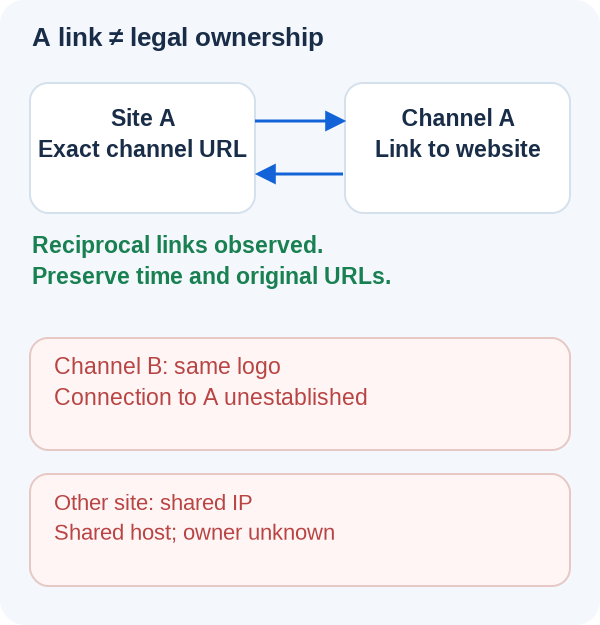
Practice. Map the connections without inventing an owner
Paste the records below into an existing Calc/Excel workbook or reproduce them on paper. An edge is a connection between two objects. For each edge specify the observation, permitted conclusion, and limitation.
id,from,to,observation
A,company-site,channel-A,website links to exact channel username
B,channel-A,company-site,channel description links back to domain
C,channel-B,company-site,same logo only
D,company-site,unrelated-site,same hosting IP only
E,channel-A,TGStat,analytics card found at observation date
Expected reasoning: A/B establish an observed reciprocal link; C/D do not establish ownership; E establishes a service card at the observation date. Negative control: remove A or replace B’s domain with an unrelated namesake. Confidence must decrease and the reason must appear in the table. A logo cannot restore a missing link.
Submit screenshots from your initial service explorations, exact URLs, an A–E connection map, and a short date-bounded conclusion. Use an agreed public channel in the main case. If data is absent, submit the input, time, and honest result. The goal is to control the tool and explain the conclusion rather than obtain a green tick at any cost.
Optional next step: Maigret for your own test username
Programming is unnecessary for the main lessons. After learning terminal basics, Maigret 0.6.6 (MIT) can help check candidates on selected platforms. Follow the official installation instructions, then run maigret --version and maigret --help. It requires Python 3.10+ and a separate environment. Avoid unverified lookup bundles.
After installation, replace YOUR-OWN-USERNAME with your agreed GitHub test username:
maigret YOUR-OWN-USERNAME --site GitHub --no-recursion --no-extracting --no-autoupdate --max-connections 1 --json ndjson --folderoutput reports --print-errors --print-not-foundRun a separately verified absent test username as a negative control. A candidate does not identify a person; network failures or access protection do not mean absence. Preserve the program version and site database. Broken detection rules require manual page checking, not a larger search. These commands are checked against the documentation and pinned CLI source and are optional.
Sources and currency
The three approaches are cross-referenced to Habr registration, DNS/CT, and username-candidate articles. Technical roles and documented usage were checked against ICANN, Telegram, TGStat, and official projects on 6 October 2026. Record incomplete coverage, plan limits, and changing search behaviour. This book does not teach retrieval from private leaks or promise to identify an owner from one service response.
Do two websites mean two sources?
Change the conditions and observe this training model. It runs in your browser and does not change your computer.
Three publications report a company relocation. Which ones provide independent support?
Choose conditions above to see an explanation of the result.
Independent exercise · Russian
Пресс-служба учебного производителя проверяет, какой канал следует включить в открытый справочник для дилеров. Два канала публикуют одинаковые фотографии оборудования и ссылаются на сайт. Адрес сайта ранее подтверждён по официальному документу организации. Все обозначения каналов в задании вымышлены.
Evidence
На 4 февраля 2027 года в разделе «Пресс-служба» домена press.example указан канал А, в описании А дана обратная ссылка на press.example. Канал Б также даёт ссылку на домен, но сайт о нём не упоминает. В полученной карточке RDAP данные владельца скрыты. В журнале сертификатов есть запись для press.example. У Б больше подписчиков.
Assignment
Составьте схему связей домена с двумя каналами. Для каждой стрелки назовите страницу, где видна ссылка, и дату наблюдения. Выберите запись для справочника.
Compare your reasoning
А можно включить со ссылкой на раздел пресс-службы: компания сама указала этот канал. У Б подтверждается только исходящая ссылка. Число подписчиков, одинаковые фотографии и сертификат домена не подтверждают его редакционную принадлежность. В справке достаточно корпоративных страниц, даты и происхождения каждой связи.
Personal practice environment
Check an excerpt, find matching lines and compute the SHA-256 of the original text. Temporary data expires after 30 minutes or when you close the environment.
Sign in