
The Quantum Threat and Harvest-Now-Decrypt-Later
Lesson lab
Launch your own container and complete the task in your browser. Your link works with your account until the workspace closes, for up to 30 minutes.
Prioritise a cryptography migration
Compare data lifetimes with migration lead times and decide which asset to address first.
Encryption can be sound today and exposed tomorrow — without a single break at transmission time. Imagine the fictional company Severny Veter (“North Wind”): its archives are encrypted, TLS is configured, the auditor is happy. Yet traffic captured today can be stored and decrypted in ten years, once a sufficiently powerful quantum computer exists. This module explains why migration starts before such a machine appears, which algorithms are at risk and which are not, and how to turn that understanding into a concrete priority list. No terminal or programming is needed here: we work with a text editor and a table.
The route: understand the mechanism → separate vulnerable algorithms from resilient ones → estimate the confidentiality horizon of practice data → apply Mosca’s inequality → write a priority register and its limits. Later in the course we will work hands-on with OpenSSL and TLS, but the decision about what to protect first is made here.
1. What exactly a quantum computer breaks
The threat is uneven. Shor’s algorithm solves factoring and discrete logarithms in polynomial time on a sufficiently large quantum computer. RSA, classical Diffie–Hellman and elliptic-curve cryptography (ECC) rest on exactly these problems: given a public key, an adversary could compute the private one. That puts TLS handshakes over ECDHE/RSA, ECDSA/RSA/EdDSA signatures, SSH keys, VPNs, code signing and certificates at risk — everything built on asymmetric cryptography over these problems. NIST explicitly lists the ECDSA, EdDSA, RSA, finite-field DH/MQV and elliptic-curve DH/MQV families as quantum-vulnerable (NIST IR 8547, section 4).
Symmetric cryptography suffers far less. Grover’s algorithm gives a quadratic speedup for key search, but as the NIST PQC FAQ explains, the full speedup requires serial execution of the steps while real attacks are parallelized; accounting for quantum hardware cost, “it is quite likely that Grover’s algorithm will provide little or no advantage in attacking AES, and AES-128 will remain secure for decades to come”, while AES-192 and AES-256 “will still be safe for a very long time”. The practical course conclusion: AES-256 and the SHA-256/SHA-384/SHA-3 hashes stay in service; the quantum threat does not require replacing them. In the IR 8547 category table AES-256 is the category 5 reference and SHA-256 the category 2 reference. Caveat: these are statements about known attacks, not a guarantee for all cases; legacy symmetric primitives below 112-bit strength (for example SHA-1 in signatures) are being retired on a separate schedule.
2. Harvest-now-decrypt-later and Mosca’s inequality
HNDL (harvest now, decrypt later) means collecting encrypted traffic today to decrypt it in the future. IR 8547 names this model as a main reason for urgency: sensitive data keeps its value for years, so the interception is already happening now, without any quantum computer. The attacker does not need to break TLS during transmission; recording the session and waiting for the technology is enough. Signatures are not subject to HNDL (forging one later does not reveal past messages), but their migration is urgent too: devices with unchangeable firmware verify signatures for decades, and replacing the verification algorithm after shipping can be impossible.
To judge the deadline, use Mosca’s inequality as presented in IR 8547: let X be the number of years the data must stay secret, Y the estimated time to complete the migration, and Z the expected time until a cryptanalytically relevant quantum computer (CRQC) exists. If X + Y > Z, you must start now. Nobody knows Z precisely — and that is no reason to wait: historically cryptographic transitions took 10–20 years (IR 8547, section 1), so Y alone is large. In the practice example we will state assumptions explicitly rather than pass estimates off as forecasts.
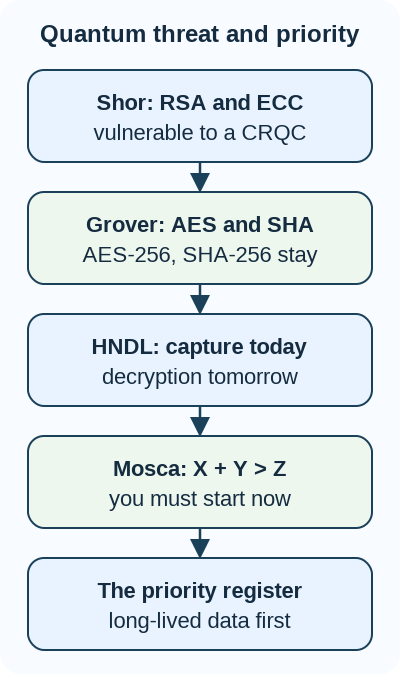
First separate vulnerable asymmetric cryptography from resilient symmetric cryptography, then assess the data horizon, and only then assign priority. Public data does not need urgent confidentiality migration.
3. Migration horizons: what the documents say
The reference dates were checked against the final NIST IR 8547 (published October 2026): NIST will deprecate quantum-vulnerable public-key cryptography after 2030 and disallow its use under NIST standards after 2035. The 2030–2035 window accommodates lower-risk legacy systems, but it does not cancel earlier deadlines for high-sensitivity US federal systems: under EO 14412 and OMB M-26-15, high value assets and high impact systems must adopt post-quantum key establishment by December 31, 2030 and post-quantum digital signatures by December 31, 2031; TLS 1.3 support is required no later than January 2, 2030. These are requirements for US federal agencies, not a law for your organization; we use them as a prioritization reference. The overall target year for completing the federal migration is 2035 (NSM-10). An important detail: IR 8547 recommends ML-KEM-768 as the default parameter set and accepts hybrid schemes as a transition mechanism.
Practice. Case “A priority register for a practice archive”
The tool is any text editor and a table (LibreOffice Calc, Excel, or plain Markdown). No network scanning: all data is fictional.
Mini-drill 1. Create a pqc-lab folder. In assets.md write one practice asset: “Client correspondence archive, AES-256 encryption, TLS keys — ECDHE P-256”. Answer in writing: which component is vulnerable to a CRQC and which is not. Expected answer: ECDHE P-256 is vulnerable (elliptic-curve discrete log), AES-256 is not.
Mini-drill 2. For the same asset set X = 15 years (the correspondence contains personal data and commercial terms) and Y = 6 years (a large organization’s migration estimate — your assumption). Compute X + Y = 21. Write down: for any Z below 21 years the migration must start now; the exact Z is unknown, so the decision follows the worst reasonable scenario.
Readiness check: you have the folder, a file with one asset, and the vulnerable/resilient components named in writing. Only then fill in the full register.
Main case:
- Add four more fictional Severny Veter assets to
assets.md: a public brochure website (TLS RSA-2048); a medical-records store (AES-256, access over TLS ECDHE); sensor firmware signatures (ECDSA P-256, devices not updateable for 12 years); an internal chat (TLS X25519, history kept 1 year). - For each asset fill a table in
risk-register.md: asset | asymmetric algorithm | confidentiality horizon X | estimate Y | X+Y | priority (high/medium/low) | one-line rationale. - Apply the rule: high priority means a long X plus vulnerable asymmetry in the transmission channel or in unchangeable signature verification; low means public data with no secret. Medical records and firmware should rank above the public website even if the website is more visible.
- Negative control: add a row “Public price list, no secrets, X = 0”. If your method gave it a high confidentiality priority, that is an error: HNDL has nothing to reveal. Check that the register distinguishes confidentiality from integrity (the price list’s signature may matter, but that is a different risk).
- Portfolio artifact:
risk-register.mdwith five assets, explicit X/Y assumptions and the date. An expected fragment (replace with your own observations):
Asset: medical records (practice example)
Asymmetric: ECDHE P-256 (vulnerable to a CRQC)
Symmetric: AES-256 (resilient to known quantum attacks)
X = 25 years, Y = 6 years (assumption), X+Y = 31
Priority: high — HNDL against long-lived data
Decision: hybrid TLS in the first migration wave- Cleanup: delete only the mini-drill drafts if they duplicate the register; keep the register itself — module 6 will need it. Do not put real employer data into the practice register.
Common mistakes: confusing “a quantum computer already broke RSA” (no, we mean a future CRQC) with “there is no threat” (HNDL makes it current); treating AES-128 as urgently vulnerable against the NIST FAQ; applying US federal deadlines to any organization as a legal requirement. Next decision: if at least one asset got high priority, move to module 2 — there we will perform a post-quantum KEM exchange and a signature in OpenSSL by hand. Bridge to the profession: in the defense track this register feeds the migration plan and procurement; in a SOC it helps explain why capturing traffic today is already tomorrow’s incident.
Where to put a check
Change the conditions and observe this training model. It runs in your browser and does not change your computer.
A team is preparing a release. Enable the independent checks and see what remains unknown.
Choose conditions above to see an explanation of the result.
Independent exercise
A clinic must prioritise two channels. For this exercise assume a cryptographically relevant quantum computer in 12 years. One supplier contract expires tomorrow.
Evidence
asset       confidentiality   migration
archive     15 years          3 years
schedule    7 days            1 year
Assignment
Build a two-row register. Add confidentiality lifetime to migration time, compare with the exercise horizon and name an assumption that could change your priority.
Compare your reasoning
The archive yields 18 years against a horizon of 12. The schedule yields just over a year. Investigate the archive first. Contract expiry does not shorten the secrecy requirement for past transfers. Repeat the calculation at 20 years and mark the uncertainty.
Observation before decision
Three ungraded cases on the priority register from the first module. The observations below are prepared practice examples, not recordings of real systems. Choose the next action and read the explanation for every option.
Mosca's inequality holds
Asset: correspondence archive. X = 15 years, Y = 6 years (assumption). A contractor report estimates Z = 12 years.
21 > 12: even on the optimistic CRQC estimate the window is already closed. The decision follows the worst reasonable scenario, and the X/Y/Z assumptions are written down explicitly.
No exact Z exists: nobody knows the CRQC arrival date. Waiting for "confirmation" spends the years the migration itself needs (Y = 6 years).
AES-256 is resilient to known quantum attacks per the NIST FAQ. The vulnerable component is key establishment (the asymmetry), not the archive's symmetric encryption.
Review every option
- Start the migration now, recording the assumptions
21 > 12: even on the optimistic CRQC estimate the window is already closed. The decision follows the worst reasonable scenario, and the X/Y/Z assumptions are written down explicitly.
- Wait until Z is officially confirmed
No exact Z exists: nobody knows the CRQC arrival date. Waiting for "confirmation" spends the years the migration itself needs (Y = 6 years).
- Urgently replace AES-256 in the archive
AES-256 is resilient to known quantum attacks per the NIST FAQ. The vulnerable component is key establishment (the asymmetry), not the archive's symmetric encryption.
What breaks in the stack
Service: ECDHE P-256 key exchange, AES-256-GCM encryption, SHA-256 hash, ECDSA P-256 certificate.
The symmetric components only face Grover's quadratic speedup; NIST considers AES-256 and SHA-256 fit for service without urgent replacement.
Both are elliptic-curve asymmetry (discrete log), vulnerable to Shor's algorithm. Key establishment is protected by a hybrid group, authentication by a PQ signature.
Replacing resilient components does not reduce quantum risk but adds work and error risk. The priority is the vulnerable asymmetry; the symmetric part stays.
Review every option
- AES-256-GCM and SHA-256
The symmetric components only face Grover's quadratic speedup; NIST considers AES-256 and SHA-256 fit for service without urgent replacement.
- ECDHE P-256 and the ECDSA P-256 certificate
Both are elliptic-curve asymmetry (discrete log), vulnerable to Shor's algorithm. Key establishment is protected by a hybrid group, authentication by a PQ signature.
- All four components at once
Replacing resilient components does not reduce quantum risk but adds work and error risk. The priority is the vulnerable asymmetry; the symmetric part stays.
Public website versus the archive
Two assets: a public brochure website (RSA-2048, no secrets) and a medical-records archive (ECDHE, data secret for 25 years). The business asks to migrate the website first — it is "visible".
A service's visibility creates no secret that can be revealed later. HNDL threatens confidentiality, and the public website has none; priority is set by the data horizon.
Archive traffic captured today will be revealed in years while the data is still secret. The website without secrets migrates later; a separate integrity risk may remain for it.
2035 is the reference for retiring vulnerable algorithms from NIST standards, not a permission to wait. For data with a 25-year horizon, Mosca's inequality requires starting long before that date.
Review every option
- Website first: it matters more to the business
A service's visibility creates no secret that can be revealed later. HNDL threatens confidentiality, and the public website has none; priority is set by the data horizon.
- Archive first: long confidentiality horizon and HNDL
Archive traffic captured today will be revealed in years while the data is still secret. The website without secrets migrates later; a separate integrity risk may remain for it.
- Migrate neither asset until 2035
2035 is the reference for retiring vulnerable algorithms from NIST standards, not a permission to wait. For data with a 25-year horizon, Mosca's inequality requires starting long before that date.
Personal practice environment
Check an excerpt, find matching lines and compute the SHA-256 of the original text. Temporary data expires after 30 minutes or when you close the environment.
Sign in